
The short answer
Duct cleaning makes sense after a remodel, a pest problem, visible debris at the vents, or heavy smoke exposure. EliteCore HVAC Solutions cleans the supply and return system and inspects the ducts, then tells you if any sections need sealing or replacement.
Ductwork is the part of a heating and cooling system most people never see. It hides in attics, under floors and behind ceilings, and in many older Culver City houses it has been there for a very long time. Over the years, dust, construction debris, pet hair and the occasional critter nest collect inside, and seams pull apart as the attic swings between summer heat and cool nights. EliteCore HVAC Solutions cleans and inspects air ducts for homes and condos in Culver City and the surrounding communities. We treat duct cleaning as both a cleaning job and an inspection, because the most useful thing a homeowner learns from it is often not how much dust came out, but whether the ducts themselves are still sound. Here is how to know when cleaning is worthwhile, what the process covers, when ducts need repair or replacement instead, what changes the cost, and how an appointment unfolds.
When cleaning is actually worth it
Not every house needs its ducts cleaned on a schedule. A tight, well-filtered system can stay reasonably clean for a long time. The cases where cleaning pays off are specific, and we would rather tell you when it is not needed than sell a service that does nothing for your home.
Los Angeles adds a few local reasons to the list. Fall Santa Ana winds blow fine dust into attics and through gaps in return ducts. Wildfire smoke during bad seasons can leave residue and odor in a system that pulled outdoor air for days. And older stucco houses often have returns that were built into wall cavities or framed with panned joists, which collect dust far faster than sealed sheet metal.
- You have finished a remodel, drywall work or floor sanding
- Dust or debris puffs out of the registers when the system starts
- Rodents, insects or birds got into the attic or ductwork
- A musty smell appears whenever the heat or AC runs
- You recently moved into a house and do not know the duct history
- Smoke from nearby fires lingered in the house for days
- Someone in the home is sensitive to dust and filters clog unusually fast
What the cleaning and inspection cover
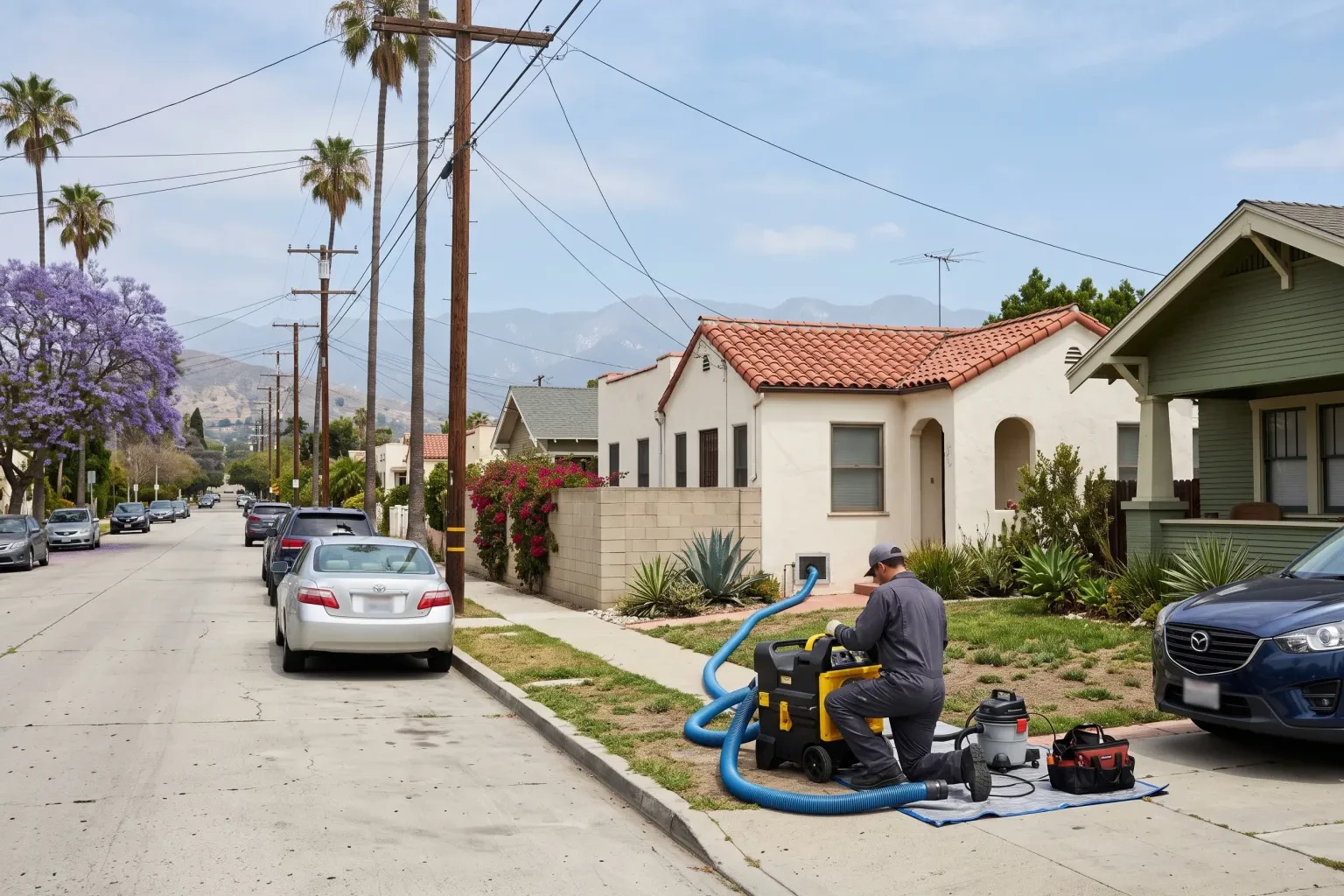
We work with the system under negative pressure, so loosened debris is pulled toward a collection unit instead of blowing into your rooms. Supply and return registers are removed and cleaned, and each branch is agitated with brushes or air tools sized for the duct type. Flexible duct needs a gentler approach than rigid metal, and we adjust accordingly.
Cleaning the ducts while ignoring the equipment would leave the job half done, so we also look at the blower compartment, the return plenum and the area around the indoor coil where dust tends to settle. Throughout the process, we watch for damage that cleaning alone cannot fix.
- Supply branches, trunk lines and every accessible register
- Return grilles, return ducts and the return plenum
- Blower housing and the visible face of the indoor coil
- Filter slot, filter size and how well the filter seals
- Disconnected joints, crushed flex runs, torn insulation jackets and gaps at boots
- Signs of moisture, mold-like growth or pest activity
Clean, repair or replace the ductwork
After the inspection, there are three common outcomes. In many homes, the ducts are in fair condition and simply dirty, so cleaning is the whole job. In others, cleaning reveals specific problems, such as a supply line that slipped off its collar or a return with a gaping seam, and those sections can be reconnected, sealed and strapped.
Sometimes the honest recommendation is replacement. Flex duct that has gone brittle in a hot attic, insulation that is crumbling, or a layout that never delivered enough air to the back bedrooms will not improve with cleaning. Replacing those runs, or redesigning the system, can do more for comfort and energy use than any amount of brushing. When that is the case, we explain what we found, show you photos where we can, and outline the options so you can decide what to do and when.
If you are also planning to replace your heating or cooling equipment, it is often sensible to address the ducts at the same time, since a new system connected to leaky ducts will not deliver its rated performance.
Factors that change the cost
Duct cleaning quotes vary from one house to the next, and we price each home after learning about it. The main variables are:
- Number of supply and return registers in the home
- Square footage and the number of HVAC systems
- Duct material: rigid metal, flex duct or panned returns in walls and joists
- Attic or crawlspace access and how tight the working space is
- How much debris, pest contamination or smoke residue is present
- Any repairs or sealing you choose to add after the inspection
How the appointment goes
Booking starts with a few questions about the size of your home, how many vents you have, and why you are considering cleaning. That helps us bring the right equipment and estimate the time. On arrival, the technician walks the house with you, checks the system, and confirms the scope.
We cover floors and furniture near the work areas, shut the system off, and connect the collection equipment. Each register and duct branch is cleaned in turn, followed by the return side and the blower compartment. When the work is finished, we reinstall the registers, put in a fresh filter if you have one available, and run the system to make sure air moves freely through every vent.
You leave the visit with a clear account of what we cleaned, what we noticed about the condition of the ducts, and any repair suggestions, without pressure to act on them that day.