
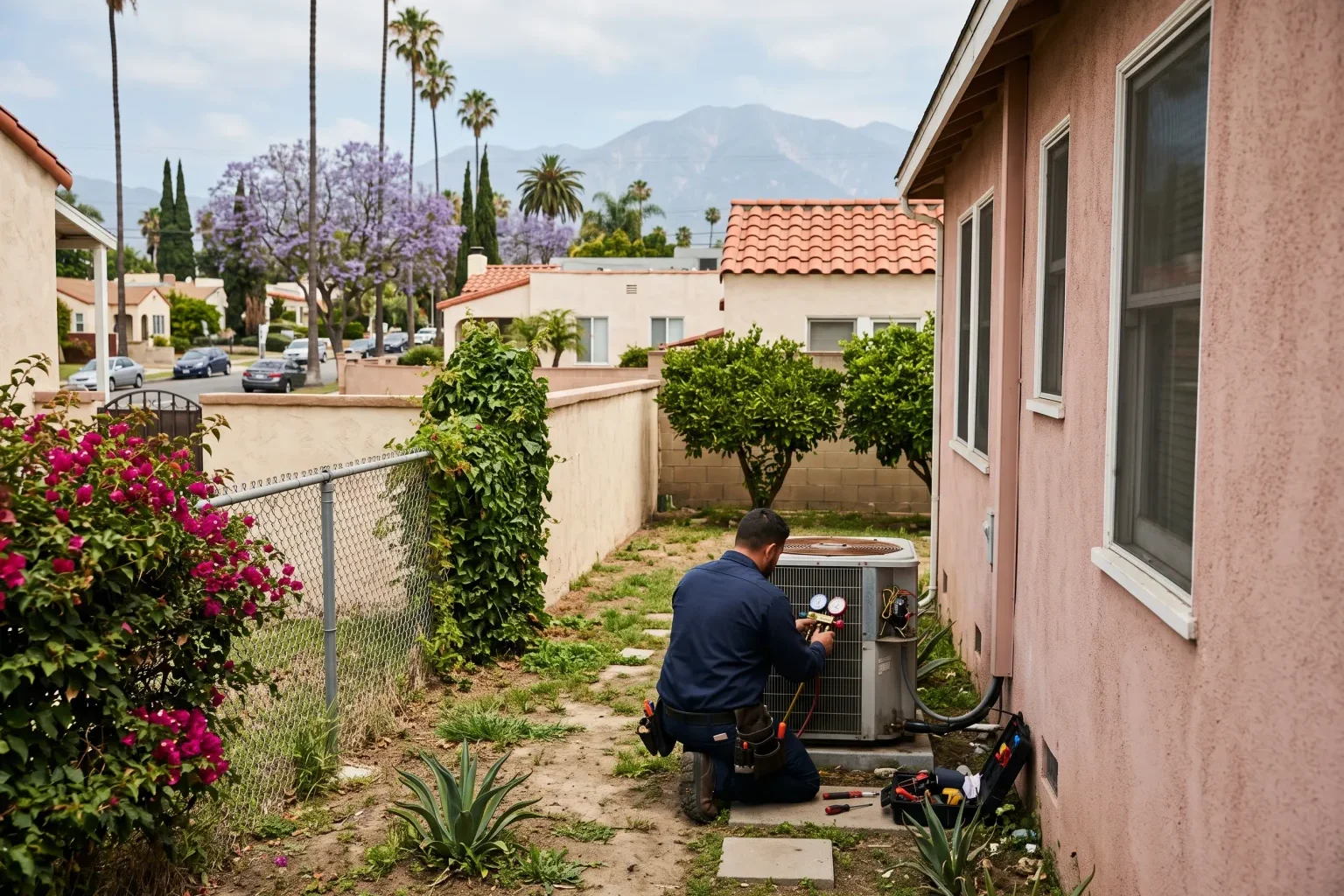
The short answer
If your AC runs but does not cool, cycles on and off, makes new noises or leaks water, it needs a diagnosis before the problem spreads to the compressor. EliteCore HVAC Solutions tests the electrical, refrigerant and airflow sides of the system, then explains your options before any work starts.
An air conditioner rarely quits all at once. More often it starts short-cycling on a warm afternoon, blows air that feels a few degrees too mild, or leaves a puddle near the furnace closet that nobody noticed until the drywall softened. EliteCore HVAC Solutions repairs central air systems, heat pumps and ductless units in Culver City and the surrounding neighborhoods, from compact condos near the coast to stucco houses whose ducts run through hot attics. Our job on a repair call is simple to describe: find the actual cause, explain it in plain terms, and fix what is broken without selling you parts you do not need. This page walks through the symptoms worth calling about, the checks a technician runs, how we think about repairing versus replacing, and what shapes the cost of a repair.
Symptoms that deserve a service call
Some warning signs are obvious, like a system that will not start. Others are quiet and easy to dismiss for weeks. The quiet ones matter because a small electrical or airflow fault can push the compressor, the most expensive part of the system, into overheating. Pay attention to how the house feels compared with last summer, not just whether the unit turns on.
On the Westside, the coastal breeze can hide a weak system for most of the season. Then a Santa Ana spell arrives in the fall, the house heats up quickly, and the unit that seemed fine cannot keep up. If any of the following sound familiar, it is worth having the system looked at before the next hot stretch.
- Supply air that feels cool but not cold, or rooms that never reach the thermostat setting
- The outdoor unit clicking on and off every few minutes
- Ice on the copper refrigerant line or on the indoor coil
- Water in the drain pan, on the floor, or staining a ceiling under an attic air handler
- Buzzing, grinding, squealing or rattling that was not there before
- A breaker that trips when the AC starts
- Musty or burnt smells coming from the vents
What a technician checks during diagnosis
A good diagnosis follows the system in order rather than guessing. We start at the thermostat and the power supply, because a wiring fault or a failed low-voltage fuse can look exactly like a dead compressor. From there we move to the outdoor condenser and the indoor equipment, testing each part against what it should be doing under load.
Airflow gets as much attention as refrigerant. Many older Culver City homes have duct runs in the attic that were installed decades ago, and crushed flex duct, disconnected boots or a clogged filter can choke a system that is otherwise healthy. Adding refrigerant to a unit that actually has an airflow problem only hides the issue for a short time, so we measure before we add anything.
- Thermostat settings, wiring and low-voltage controls
- Capacitors, contactors and disconnect at the outdoor unit
- Compressor and condenser fan motor operation and amperage draw
- Refrigerant pressures and temperatures compared with the manufacturer's targets
- Evaporator coil condition and the condensate drain line
- Blower motor, filter, and static pressure across the duct system
- Visible duct connections in the attic or crawlspace where accessible
Repair it or replace it: how we frame the choice
Most calls end with a straightforward repair. A failed capacitor, a worn contactor, a blocked drain or a seized fan motor can be fixed in one visit, and the system goes back to normal. Replacement only enters the conversation when the failed part is a major component, when the system uses a refrigerant that is being phased out, or when repairs have been stacking up year after year.
When that happens, we lay out both paths side by side instead of pushing one. You will hear what the repair involves, how the rest of the system looks, and what a replacement would change in comfort and operating efficiency. Some homeowners prefer to fix the unit and plan a replacement for a later season; others would rather stop putting money into older equipment. Either is reasonable, and the decision stays with you.
If a heat pump makes sense as a replacement, rebate eligibility depends on which utility serves your address. LADWP residential customers can apply for rebates on qualifying heat pump systems after installation, while many homes outside the City of Los Angeles are served by Southern California Edison instead, and the available offers differ. We confirm the current program for your address before mentioning it in any quote. The federal 25C tax credit for heat pumps does not apply to systems installed after 2025.
What affects the cost of an AC repair
We do not publish flat prices online because two systems with the same symptom can need very different work. What we can do is explain the factors, so the estimate you receive makes sense before you approve it.
- Which part failed: small electrical components are far simpler than a compressor, coil or blower motor
- Access: an air handler in a tight attic or a condenser on a roof takes more time than a unit in a side yard
- Refrigerant type and whether a leak has to be located and sealed before recharging
- Part availability for older or less common equipment brands
- Whether related damage, such as a water-soaked ceiling or corroded wiring, needs attention at the same time
How a repair visit works
When you contact us, we ask a few questions about the symptoms and the age and location of your equipment, then set a time window that works for you. The technician arrives, asks what you have noticed, and begins the diagnosis described above. If a quick fix like clearing a drain line is all it takes, you will know within minutes.
For anything larger, you get a clear explanation of what failed and why, along with the repair options and their cost before any work begins. Once you approve, the technician completes the repair, runs the system through a full cycle, and checks temperatures at the supply vents to confirm it is cooling properly. Before leaving, we point out anything else we noticed, such as a filter that needs changing or duct sections worth sealing, so you can plan ahead rather than be surprised later.
AC Repair by city
- AC Repair in Los AngelesLocal service & repairs
- AC Repair in InglewoodLocal service & repairs
- AC Repair in Beverly HillsLocal service & repairs
- AC Repair in West HollywoodLocal service & repairs
- AC Repair in Santa MonicaLocal service & repairs
- AC Repair in HawthorneLocal service & repairs
- AC Repair in El SegundoLocal service & repairs
- AC Repair in Manhattan BeachLocal service & repairs
- AC Repair in LawndaleLocal service & repairs
- AC Repair in GardenaLocal service & repairs
- AC Repair in Hermosa BeachLocal service & repairs
- AC Repair in Huntington ParkLocal service & repairs